
Solar Mounting Hardware Suppliers in China: A Buyer Checklist for Aluminum Grade, Wind Load Data, and Corrosion Risk
Solar mounting hardware looks simple until a shipment reaches the roof. A rail that is slightly underweight, a clamp with weak anodizing, or a bracket without credible wind-load data can turn a low unit price into a warranty problem. For importers, EPC contractors, and distributors buying from China, the key is not only finding a factory that can extrude aluminum. The key is proving that the supplier can control alloy, tolerances, surface treatment, fasteners, and documentation across repeat orders.
This checklist is written for buyers comparing Chinese suppliers of solar panel mounting rails, mid clamps, end clamps, roof hooks, L-feet, ground-mount brackets, and related accessories.
Start with the application, not the catalog
Before asking for a quotation, define the installation environment. Rooftop residential systems, commercial flat roofs, coastal projects, agricultural ground mounts, and carport structures all place different stress on the hardware. A serious supplier should ask about panel size, roof type, wind zone, snow load, tilt angle, module frame thickness, and fastener requirements. If a factory immediately quotes from a generic catalog without these questions, treat it as a trading conversation rather than an engineering conversation.
Buyers should request drawings for the exact rail profile and clamp design being quoted. Do not accept a photo and a weight estimate as the technical basis for an order. The drawing should show dimensions, wall thickness, hole spacing, allowable tolerances, and compatible module frame range.
Verify aluminum grade and extrusion control
Most solar mounting rails use aluminum alloy such as 6005-T5 or 6063-T5, but the grade written on a quotation is not enough. Ask for mill certificates, incoming material records, and recent tensile test data. For larger orders, consider a pre-shipment sample cut and independent material verification. A small reduction in wall thickness or temper consistency may not be visible during a visual inspection, but it can affect load performance and long-term stability.
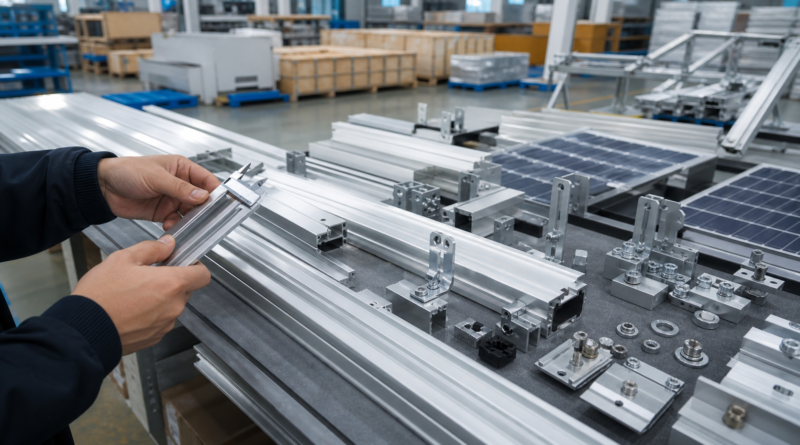
Check profile straightness, burr control, hole alignment, and cut-end finishing. For rails packed in long lengths, also confirm how the supplier prevents abrasion during transport. Thin protective film, insufficient spacer material, and loose bundles can create scratches before the goods even leave the factory.
Ask for credible load data
Wind-load and snow-load claims should be supported by engineering calculations or test reports that match the quoted system. Buyers should be cautious when a supplier provides a report for a different rail profile, a different clamp, or a general mounting system that does not match the project. For distributor orders, ask whether the supplier can provide project-specific calculation support when your end customer requires documentation.
A practical review includes rail span limits, clamp pull-out strength, roof hook capacity, screw specifications, and whether stainless steel fasteners are included or optional. If the supplier substitutes fasteners locally at the last minute, the system may pass a sample review but fail under real installation conditions.
Control corrosion risk before price negotiation
Outdoor hardware faces UV, rain, salt spray, and galvanic corrosion. Ask for anodizing thickness, salt spray test results, stainless steel grade for bolts and nuts, and whether dissimilar metals are isolated where needed. Coastal markets require a different risk standard than inland residential projects.
For black anodized rails and clamps, ask for color consistency standards and scratch handling procedures. Black systems are popular in residential markets, but visible color variation can trigger customer complaints even when the hardware is structurally acceptable.
Sample review checklist
- Confirm rail profile dimensions against the drawing, not only against a sample photo.
- Measure clamp fit with the actual module frame thickness used in your market.
- Check bolt thread quality, washer thickness, and whether stainless grade is marked or documented.
- Review anodizing thickness and surface consistency on cut ends and visible faces.
- Test packing by simulating handling of long rails, mixed accessory cartons, and pallet movement.
Commercial terms that deserve attention
Solar hardware orders often contain many small accessory SKUs. A supplier may quote rails competitively but lose control of clamps, grounding clips, roof hooks, or spare fasteners. Require a packing list by component, carton marking by SKU, and a spare-parts policy. If your customers install in the field, a missing accessory can delay the whole project.
Buyers should also confirm whether tooling is supplier-owned, shared, or buyer-owned. If a rail profile is customized, clarify tooling maintenance, drawing ownership, and whether the supplier can sell the same profile to other buyers.
When to slow down
Red flags include inconsistent rail weight between samples and quotation, unwillingness to provide drawings, reports that do not match the offered system, vague stainless steel specifications, and pressure to skip inspection because the goods are “standard.” Standard hardware still needs controlled production.
GlobalSource.Click can help buyers verify suppliers, compare sourcing options, arrange checks, or submit sourcing requests. Contact via Submit Request or WhatsApp: +86 188 5050 9900.