
Stainless Steel Cookware Suppliers in China: A Procurement Guide to Steel Grade, Induction Base, and Handle Safety
Stainless steel cookware is a mature export category, but mature does not mean simple. Buyers still face complaints about rust spots, uneven heating, loose handles, poor lid fit, induction failure, carton damage, and inconsistent finishing between batches. The challenge is that many defects appear only after repeated cooking, dishwasher exposure, or rough parcel delivery. A good sourcing process should test the cookware as a kitchen product, not only as a shiny metal item.
This procurement guide is for importers, retailers, hospitality buyers, and private-label brands sourcing pots, saucepans, frying pans, stockpots, lids, steamers, and cookware sets from Chinese suppliers.
Clarify the steel structure
Suppliers may describe cookware as 201, 304, 316, or 430 stainless steel, but a set often uses different grades in different parts. The inner body, outer body, lid, handle, rivet, knob, and induction base may not be the same material. Buyers should request a bill of materials and confirm which food-contact surfaces use which grade.
For many markets, 304 stainless steel is expected for food-contact surfaces in mid-range cookware. 430 stainless steel is commonly used for magnetic induction layers. 201 can reduce cost, but it may create higher corrosion risk depending on use conditions and market expectations. Do not rely only on product descriptions; use material certificates and, for important orders, independent alloy testing.
Induction base performance needs real testing
Induction compatibility is not just a sticker on the carton. Check base diameter, magnetic layer coverage, bonding method, base flatness, and heating consistency. A cookware piece that works on one induction cooker may perform poorly on another if the magnetic base is too small or not flat enough.
Ask the supplier to test on several induction cookers and provide base flatness tolerances. For private-label cookware, buyers should test boil time, hot spots, noise, and whether the base warps after heating and cooling cycles. If your market has many returns through e-commerce channels, these tests should be completed before mass production, not after the first container arrives.
Handle and rivet safety
Handle failure is both a product quality issue and a safety risk. Buyers should check rivet strength, spot welding quality, handle temperature, screw locking method where applicable, and whether the handle remains stable after repeated heating cycles. For heavy stockpots or hotel-use cookware, load testing is especially important.
Look closely at the joint area. Rough polishing around rivets can trap residue, while weak welding can loosen during use. If a supplier offers both welded and riveted handle options, compare the real market use case rather than choosing only by appearance.
Surface finish and rust complaints
Rust complaints often come from material selection, polishing contamination, poor passivation, or improper cleaning instructions. Buyers should ask how the factory prevents carbon steel contamination during polishing and whether passivation is used. For brushed finishes, confirm grain direction and acceptable scratch standards. For mirror finishes, define how visible marks will be judged under normal light.
Care instructions also matter. Some markets expect dishwasher safety, while some low-cost cookware should be hand-washed. If the listing or packaging promises dishwasher safety, test it. Do not let marketing copy exceed the product’s real performance.
Cookware sample checklist
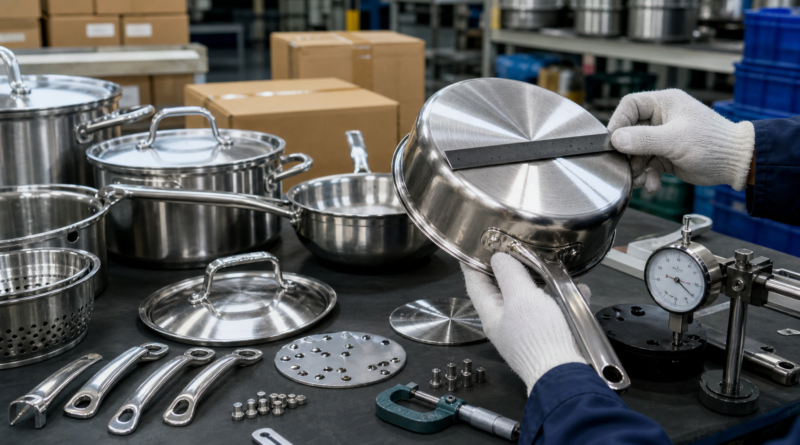
- Measure body thickness, base thickness, weight, and lid fit against the approved specification.
- Check material grade for body, base, lid, handle, rivets, and knobs.
- Test induction performance, base flatness, heating consistency, and warping after thermal cycles.
- Inspect polishing quality around handles, rims, rolled edges, and rivets.
- Simulate carton drop and parcel handling for cookware sets sold online.
Packaging for retail and e-commerce
Cookware is heavy, reflective, and easily scratched. A supplier that packs well for palletized retail shipments may still fail for individual parcel delivery. Buyers should confirm inner bags, separators, lid protection, handle protection, carton strength, and whether the product moves inside the box. For cookware sets, nested packing must protect both the inner and outer surfaces.
If the product is sold through Amazon or other e-commerce channels, packaging should be validated with a realistic drop test. Cosmetic dents or scratches can produce returns even when the cookware is technically usable.
Supplier selection signals
Strong suppliers can explain material choices, show QC records, maintain approved samples, and discuss market-specific requirements such as LFGB, FDA-related food-contact expectations, or retailer testing protocols. Weak suppliers tend to focus on catalog photos and price tiers without discussing performance risk.
Before placing a repeat order, compare pre-production samples with mass-production goods. Small changes in weight, finish, handle design, or base construction can affect the buyer’s brand reputation.
GlobalSource.Click can help buyers verify suppliers, compare sourcing options, arrange checks, or submit sourcing requests. Contact via Submit Request or WhatsApp: +86 188 5050 9900.