
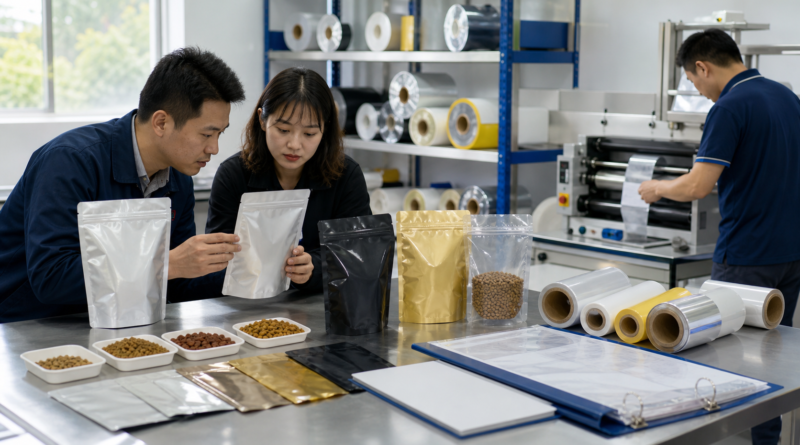
Pet Food Packaging Suppliers in China: A Buyer Checklist for Barrier Film, Zipper Seals, and Odor Control
Pet food packaging is a small part of product cost, but it carries a large share of customer complaints. A weak zipper, poor oxygen barrier, ink odor, pinholes, or unstable pouch dimensions can damage shelf life and make a private-label product look cheap. For cross-border e-commerce sellers and importers, packaging failure also creates returns that are difficult to recover from.
China has many capable flexible packaging converters, but buyers need to separate real food-grade packaging manufacturers from trading companies that outsource every process. The right supplier should understand film structure, sealing windows, print control, pouch forming, migration requirements, and export documentation.
Define the product before asking for a pouch price
Do not start with pouch size alone. A supplier needs to know whether the product is dry kibble, freeze-dried treats, wet food, powder, supplements, or snacks with oil content. Each product has different oxygen, moisture, grease, puncture, and odor-control requirements. A pouch that works for dry treats may not protect high-fat kibble during long storage.
Give suppliers target filling weight, product density, storage period, sales channel, target market, expected shelf life, and whether nitrogen flushing or vacuum sealing will be used. Ask them to recommend a film structure and explain why. A good supplier can discuss PET, PE, CPP, aluminum foil, metallized film, EVOH, kraft paper laminates, and recyclable options without turning every answer into a sales pitch.
Barrier film questions that reveal supplier capability
Many quotations list film thickness but not barrier performance. Thickness alone does not tell buyers whether the pouch protects aroma, fat stability, and crunch. Ask for oxygen transmission rate, water vapor transmission rate, and the testing method where relevant. For export retail products, also ask whether the supplier can provide food-contact material declarations for the destination market.
If the supplier cannot explain the film layers, adhesive type, and intended storage conditions, be cautious. Some low-cost pouches look acceptable during sample review but become soft, smelly, or delaminated after warehouse storage.
Zipper and seal checklist
- Open and close the zipper at least 30 times on random samples.
- Check whether powder or small pellets block the zipper channel during real filling.
- Request heat-seal strength test data for top, side, and bottom seals.
- Verify that the sealing window matches your co-packer’s filling equipment.
- Check pouch standing stability after filling, especially for wide-bottom bags.
- Inspect tear notch placement and whether consumers can open the pouch cleanly.
Odor, ink, and appearance risks
Pet owners notice odor quickly. If a pouch has a strong solvent smell, even a good pet food formula can feel unsafe to consumers. Ask for low-odor ink and adhesive control, sufficient curing time, and retained production samples. Do not approve mass production immediately after fresh printing if the pouch still carries noticeable ink or adhesive odor.
Print registration is another common issue. Buyers should review barcodes, nutrition panels, regulatory symbols, and color matching under normal lighting. If the product is sold on Amazon, Chewy, Shopify, or supermarket channels, poor packaging appearance reduces trust before the customer even reads the ingredients.
Trial order strategy
For a new pet food packaging supplier, begin with a controlled trial rather than a full annual order. Approve artwork files carefully, confirm cylinder or digital print setup, and request pre-production samples made from the actual film structure. During the trial, test filling, sealing, carton packing, and warehouse storage before scaling.
A buyer should also confirm minimum order quantity by SKU, lead time for repeat orders, color control process, and how the supplier handles complaints. For fast-growing private-label brands, the ability to repeat the same pouch quality is more important than saving a small amount on the first purchase.
Buying advice
Choose pet food packaging suppliers that can speak in terms of product protection, not just pouch appearance. The best suppliers help buyers reduce leakage, odor complaints, shelf-life risk, and fulfillment damage. Keep every approved film structure, artwork version, and sample record organized so future reorder disputes can be resolved quickly.
GlobalSource.Click can help buyers verify packaging suppliers, compare sourcing options, arrange factory or sample checks, or submit sourcing requests. Contact via Submit Request or WhatsApp: +86 188 5050 9900.